Founder Guide
This guide explains each part of the season the way the League designed it: what you do, how, and the reason behind it. Read it once before you register and again before your first Stage Final Challenge.
Watch it first. Four minutes, narrated, on the real screens.
The season, and why it is a season
You register once, then build in public for eight months. One State Champion is crowned on May 19, 2027.
A pitch competition rewards one good afternoon. The League is built to reward what you actually did between September and May. That is why the season is long, why you report every week, and why the prize capital is non-dilutive: $500,000 for the Founders Cup and $25,000 for each of three Regional Champions, with no equity taken, ever. The League wants you to keep the company you built.
The three phases exist so the field narrows on evidence. The Campus Activation Phase gets every strong venture registered by the November 20 cutoff. The Playoff puts 36 of them through eight tracked sprint weeks with a mentor each, then three live Regional Championships. Selection Sunday names ten. Seven more weeks of building, scores freeze on May 5, and the State Championship is decided on stage.
- 1Register before November 20, 2026. There is no second window.
- 2Your campus lead nominates 10 to 15 ventures. Make sure they know you exist.
- 3The 36 are announced December 4. Sprint weeks run January 15 to March 5.
- 4Regional Championships March 9 to 11 in Cincinnati, Columbus, and Cleveland. Selection Sunday March 14. Blackout May 5. Championship May 19.
| DATE | WHAT HAPPENS |
|---|---|
| September 29, 2026 | Public announcement |
| November 20, 2026 | Campus Activation Phase data cutoff |
| December 4, 2026 | 36 Playoff ventures announced, mentors assigned |
| January 15, 2027 | PLAYOFF OFFICIALLY STARTS |
| March 9, 2027 | Cincinnati Regional Championship (South Ohio) (12 ventures, 5 judges) |
| March 10, 2027 | Columbus Regional Championship (Central Ohio) |
| March 11, 2027 | Cleveland Regional Championship (North Ohio) |
| March 14, 2027 | Selection Sunday (3 auto + 7 selected = 10) |
| May 5, 2027 | Blackout |
| May 19, 2027 | STATE CHAMPIONSHIP (State Champion crowned, $500,000 awarded) |
Registration, and why you are told your stage
One flow, five steps, about ten minutes. The League tells you your stage and profile from what you have already done.
Founders are bad at judging their own stage. Some undersell, most oversell, and a league where everyone picks their own starting line is not a fair race. So the discovery questions ask only about what exists today: a documented problem, a defined target customer, an entity, an MVP, users, revenue, funding. Team size never changes your stage, and neither does having an entity; a solo founder with a documented problem and a defined target customer is Stage 1. The stage those answers support is the stage you get, with the reasons written out. Everyone in your cohort earned their starting line the same way.
Your profile is different. It is not a ranking. It describes how ventures like yours grow, so the League can give you the right advice and hold you to the right scale threshold later. A services firm and a software marketplace should not be told to chase the same milestones.
Some challenges are pre-checked from your answers because you have already done them. Confirm them honestly. An official will check every one of them at your first Stage Final Challenge review.
If your answers place you above Stage 0, every stage below you is credited in full the moment you go live: 250 for a Stage 1 venture, 650 at Stage 2, 1150 at Stage 3, 1800 at Stage 4. That is not a head start. It is the same number a Stage 0 venture reaches by clearing those stages the long way, and your registration answers are the proof an official checks.
- 1Your Venture: name, one line, university, team.
- 2Discovery: yes or no on what exists, with follow-ups for each yes.
- 3Your Profile: read your stage reasons and your profile. You do not pick either.
- 4Challenges: confirm the pre-checked items. Uncheck anything you cannot prove.
- 5Scorecard: your starting credit, what your stage is worth, and your road from Stage 0 to Stage 4 with the stages credited, the one you start in, and the ones ahead.
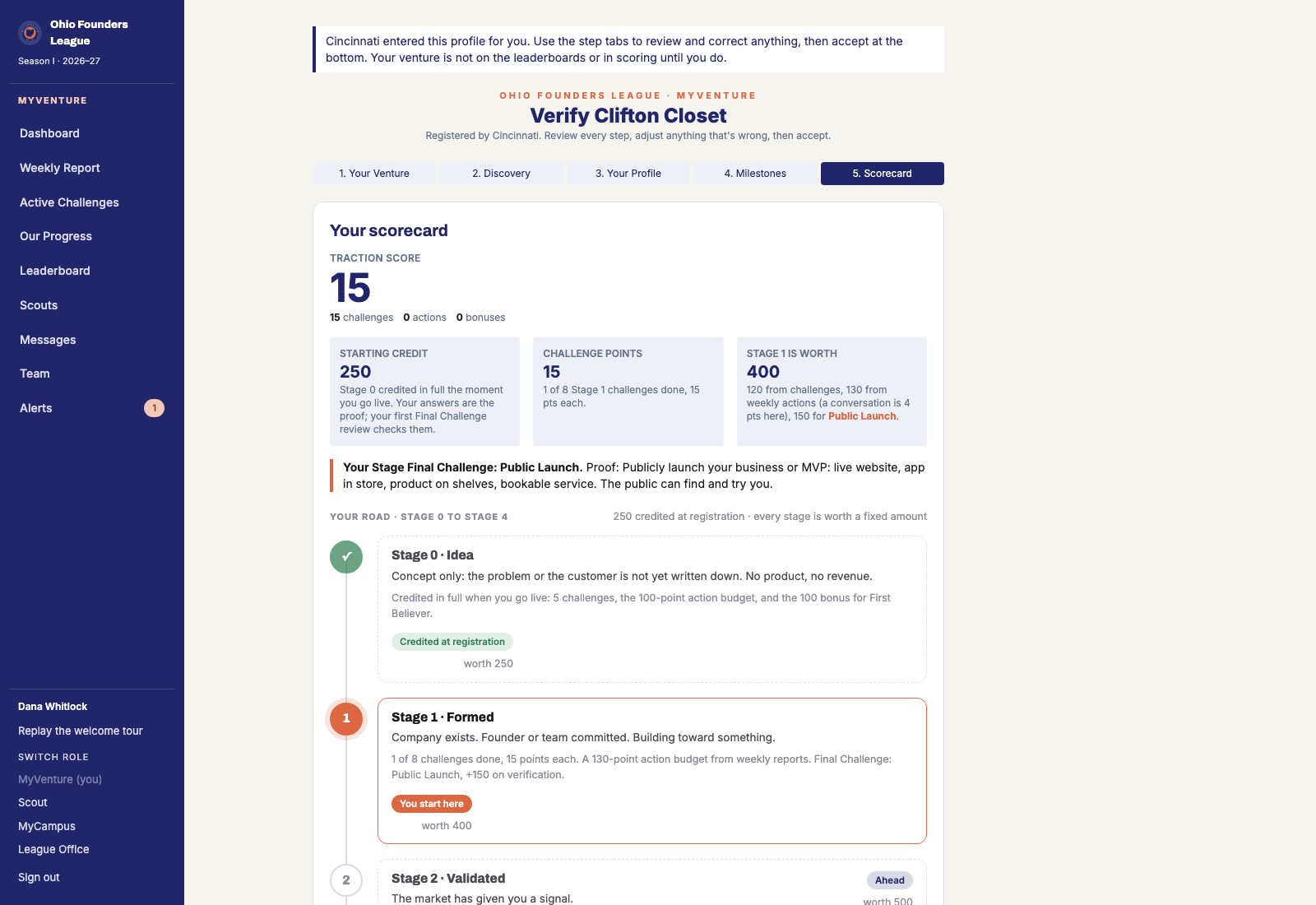
| STAGE | WHAT IT MEANS | HOW YOU GET PLACED HERE |
|---|---|---|
| Stage 0 · Idea | Concept only: the problem or the customer is not yet written down. No product, no revenue. | Anything short of Stage 1: the problem is not yet documented, or the target customer is not yet defined. (Documented = no, or target customer persona = not ticked) |
| Stage 1 · Formed | Company exists. Founder or team committed. Building toward something. | The problem is documented and the target customer persona or segment is defined. An entity is not required, and one founder is enough. (Documented problem, solution, and customer = yes; Follow-up: target customer persona or segment defined = ticked) |
| Stage 2 · Validated | The market has given you a signal. | At least two market signals from: value milestones achieved, an MVP that real users have tested, customer LOIs. (Each validation signal you tick counts as one; MVP = yes and users tested = yes counts as one; Follow-up: customer LOIs = yes counts as one) |
| Stage 3 · Operating | Money coming in. Business model functioning. | Paying customers, at any revenue level. (Follow-up: paying customers = yes) |
| Stage 4 · Scaling | Past 'does this work'. Now it's 'how big can this get.' | Paying customers at $200K+ annual revenue, or $200K+ raised. (Follow-up: paying customers = yes, and revenue range = $200K+; or follow-up: raised $200K+ in venture funding = yes) |
The Traction Score, and why every stage is worth a fixed amount
Traction Score = the worth of every stage you have cleared + your progress in the current stage + money milestones. Stage 0 is worth 250, Stage 1 is 400, Stage 2 is 500, Stage 3 is 650, Stage 4 is 830. It is the number Scouts score you on.
The score has to be something a founder controls completely and a judge can trust completely. So nothing external moves it. Scouts picking you do not move it. Your campus lead cannot touch it. A judge cannot edit it. It goes up when you report work, complete a challenge, cross a money milestone, or clear a Stage Final Challenge, and it goes down in exactly one case: an official audit finds something you claimed was not true.
Every stage is worth a fixed amount, made of three parts: its challenges, an action budget that your weekly reports fill, and its Final Challenge bonus. That is what makes the score a standing rather than a log of activity. Time in a stage cannot out-score clearing it. When an official verifies your Final Challenge, the whole stage is credited in full, whatever you had marked or reported, so a founder who reaches the gate early simply gets there faster. A venture placed at a higher stage at registration gets the same credit for the stages below it. The road and the shortcut arrive at the same number.
The nine weekly actions pay different rates at different stages on purpose. At Stage 0 the most valuable thing you can do is talk to customers, so a conversation is worth 5 points. By Stage 3 the most valuable things are deals and customers, at 5 points each, and conversations pay 2. Every action counts at every stage, so a Stage 0 founder who lands a customer is rewarded and prompted to advance. Each stage's action budget pays the first 60% at full rate, the next 40% at half rate, and anything past the cap at 10%: reporting never becomes pointless, but the way up is always the Final Challenge.
Speed is rewarded on top. Clear a stage's Final Challenge within 4 weeks of entering the stage and the bonus is multiplied by 1.5. A venture moving through stages that quickly is on a rocketship ascent, and the score should say so.
- 1Report units, not feelings: one conversation of 10 minutes or more, ten messages, one piece of content, one event, one document, one signed deal, one customer, one meaningful release, one mentor meeting of 30 minutes or more. Revenue is reported separately, in dollars.
- 2Check the rate for your stage below and how much of your action budget is left. The dashboard shows both.
- 3Use the Score Sandbox at the end of this guide to see how a stage, a week of numbers, and a verified Final Challenge turn into a score.
| STAGE | CHALLENGES | ACTION BUDGET | STAGE FINAL CHALLENGE | BONUS | STAGE WORTH | STARTING CREDIT IF PLACED HERE |
|---|---|---|---|---|---|---|
| 0 Idea | 5 × 10 | 100 | First Believer | 100 | 250 | 0 |
| 1 Formed | 8 × 15 | 130 | Public Launch | 150 | 400 | 250 |
| 2 Validated | 6 × 20 | 180 | First Dollars | 200 | 500 | 650 |
| 3 Operating | 7 × 25 | 225 | Proven Demand | 250 | 650 | 1150 |
| 4 Scaling | 9 × 30 | 260 | Built to Last | 300 | 830 | 1800 |
Weekly actions, and why they taper
Nine actions, each worth a set number of points at your stage, filling a per-stage budget.
The weights push you toward the work that matters at your stage. The budget stops the score from rewarding time. A founder who reports thirty conversations a week for a semester has done something, but not more than a founder who cleared two stages in that time, and the score should not say otherwise.
The taper is gentler than a hard cap. You always see the rate you are earning at, on the report page and on the dashboard, so nothing about it is a surprise.
- 1Weekly Report shows this stage's weights and your budget: how much is used, and whether you are at full rate, half rate, or past the cap.
- 2When the budget is full, finish the challenges and submit your Final Challenge proof. The next stage opens a fresh budget at its own weights.
| WEEKLY ACTION | UNIT | STAGE 0 | STAGE 1 | STAGE 2 | STAGE 3 | STAGE 4 |
|---|---|---|---|---|---|---|
| Customer conversations | 1 per conversation (10+ min) | 5 pts | 4 pts | 3 pts | 2 pts | 1 pts |
| Outreach sent | 1 per 10 messages | 3 pts | 3 pts | 2 pts | 1 pts | 1 pts |
| Content published | 1 per piece | 3 pts | 2 pts | 2 pts | 1 pts | 1 pts |
| Events attended / pitched | 1 per event | 2 pts | 2 pts | 2 pts | 2 pts | 2 pts |
| Contracts / proposals sent | 1 per document | 1 pts | 2 pts | 3 pts | 4 pts | 3 pts |
| Deals closed | 1 per signed deal | 2 pts | 3 pts | 4 pts | 5 pts | 5 pts |
| New customers acquired | 1 per customer | 2 pts | 3 pts | 4 pts | 5 pts | 5 pts |
| Product updates shipped | 1 per meaningful release | 2 pts | 4 pts | 3 pts | 2 pts | 2 pts |
| Mentor meetings completed | 1 per meeting (30+ min) | 2 pts | 2 pts | 2 pts | 2 pts | 2 pts |
| Action budget per stage | full rate to 60%, half rate to 100%, then 10% | 100 | 130 | 180 | 225 | 260 |
Money milestones, and why revenue is not a weekly action
Revenue is reported in dollars and adds up across the season. Each band pays once, at any stage, from $100 to $1,000,000. All seven together are worth 590.
A $1M deal at Stage 1 should not be worth two points, and at Stage 3 it should not be worth fifty thousand. Scoring revenue per dollar does both. Bands do neither: every dollar counts toward the next milestone, real money matters a lot, and one deal cannot decide the season. The seven bands together are worth about the same as clearing Stage 2.
A big win at a low stage is never wasted. Crossing $100 is automatically the proof for First Dollars, so the founder who lands a customer early submits that proof and moves up, and the stages they pass are credited in full. Money milestones are verified at your next Final Challenge review like everything else.
- 1Enter dollars actually received this week in the revenue field of the Weekly Report. Not booked, not promised: received.
- 2Watch the next milestone on the report page. Crossing one shows up in your result the moment you submit.
- 3Keep the bank statement. The official will ask for it.
| CUMULATIVE REVENUE | POINTS | RUNNING TOTAL |
|---|---|---|
| $100 | +10 | 10 · Proof for the First Dollars Final Challenge |
| $1,000 | +20 | 30 |
| $10,000 | +40 | 70 |
| $50,000 | +70 | 140 |
| $100,000 | +100 | 240 · Counts toward Built to Last evidence |
| $500,000 | +150 | 390 |
| $1,000,000 | +200 | 590 |
The weekly report, and why it is weekly
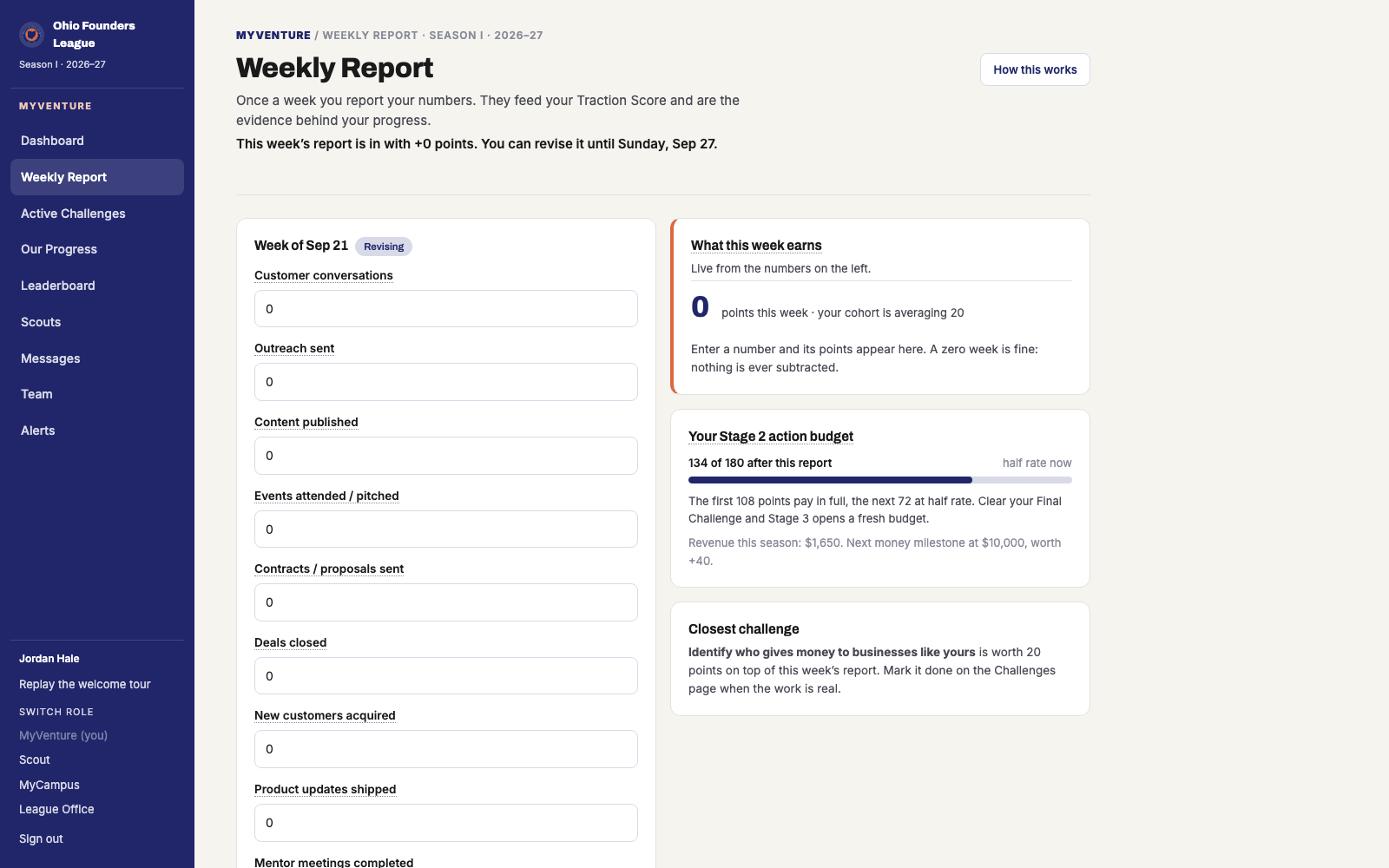
Nine actions and your revenue, once a week, due Sunday at midnight. Revise until the week closes.
Weekly is the shortest cadence a founder can sustain and the longest the League can wait. A month is long enough to hide a bad stretch. A week is not. Reporting every week turns the season into a record of what you did, and that record is what officials verify, what Scouts read, and what judges interpret as momentum.
The report is also where the League compares you to your cohort. Each sprint week, your score increase minus the cohort's average increase is your Sprint VAA, value added above average. Cumulative VAA across the Playoff sets your rank within the cohort, and that rank is the Traction slice of League Scoring. It means a Stage 0 venture that outbuilds its cohort can out-score a Stage 3 venture on traction. Raw score never decides the Playoff. Progress against your peers does.
Streaks exist because consistency is the best predictor the League has. Four straight weeks earns Consistent, eight earns Dedicated, a full season earns Iron Will. Missing a week never costs points, but it resets the streak and it shows.
- 1Open Weekly Report. Enter units for each action and dollars for revenue. The panel beside the form adds up the points as you type, applies the stage taper, and shows any money milestone you would cross.
- 2Submit. You see the points, your action budget, your stage progress, your Traction Score, your cohort rank, and any badge you earned.
- 3Revise any time before Sunday midnight. Points update with the revision.
- 4Only report what happened this week. Scouts and your campus lead can see the record.
Challenges, and why each one exists
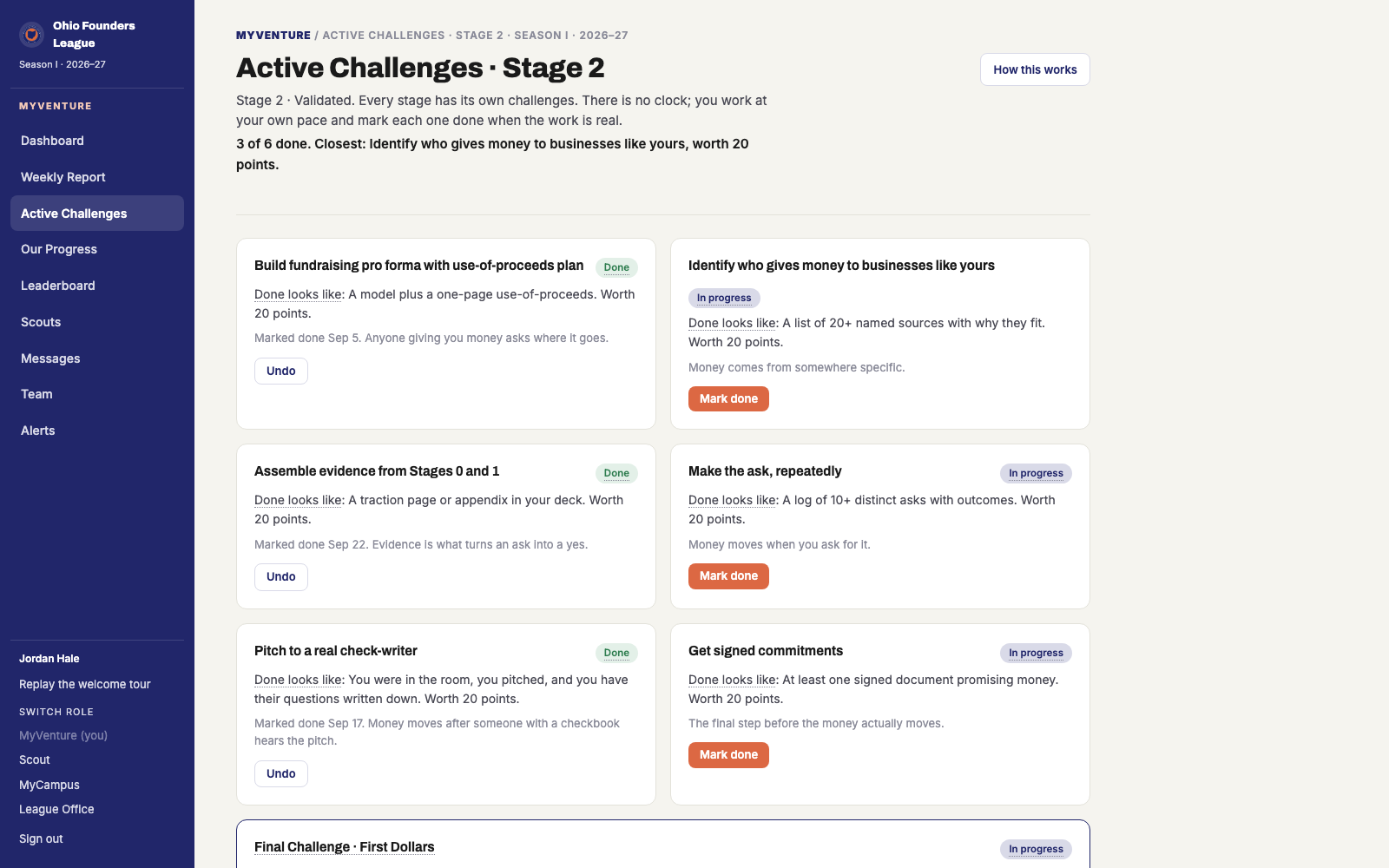
A short list per stage on the Active Challenges page. Each pays once. Finish the list and you are ready for the stage's Final Challenge. Our Progress shows every stage on one timeline.
The challenges are the work that gets a venture from one stage to the next, in the order that works. Stage 0 is about knowing what you are building and for whom. Stage 1 is about being findable and having something to sell. Stage 2 is about asking for money until someone says yes. Stage 3 is about proving people come back. Stage 4 is about building the machine. Each list is short because a short list you finish beats a long list you admire.
Every challenge shows what done looks like, because done has to mean the same thing for every venture in the cohort. A landing page with no call to action is not done. A deck you have never presented is not done. Mark a challenge done when you could show the evidence to an official, and keep the evidence.
Later and N/A exist so honesty is never punished. A Stage 1 challenge that is not the right move yet can wait. A challenge that does not fit your profile can be marked N/A and does not block the Stage Final Challenge.
- 1Open Active Challenges. Each card says what done looks like and what it is worth.
- 2Work the list. Mark done only what you can prove.
- 3Use Later for timing and Not applicable for fit. Anything can be undone.
- 4Open Our Progress to see every stage, what you have cleared, and what is still ahead.
| STAGE | CHALLENGE | DONE LOOKS LIKE |
|---|---|---|
| 0 Idea | Write down your problem, solution, and differentiation | A written one-pager you could hand to a stranger. |
| 0 Idea | Identify your specific target customer | A one-sentence description of a real person you could go find today. |
| 0 Idea | Research your competition | A short table of alternatives with what they do well and poorly. |
| 0 Idea | Develop your elevator pitch | You can deliver it without notes and get a follow-up question. |
| 0 Idea | Get feedback from real people | Notes from 5+ conversations with people you did not know before. |
| 1 Formed | Build a basic website or landing page | A live URL with a call to action (waitlist, contact, buy). |
| 1 Formed | Create a pitch deck | A deck you have presented at least once. |
| 1 Formed | Build a fundraising pro forma | A spreadsheet with assumptions you can defend. |
| 1 Formed | Define your launch offer | A written offer with a price that you could put on a landing page today. |
| 1 Formed | Run a soft launch with 5 real users | Five strangers used it and you recorded what happened. |
| 1 Formed | Set pricing and show it to prospects | A price list or page that prospects have reacted to. |
| 1 Formed | Find an advisor who's built and shipped | A named advisor with a recurring check-in. |
| 1 Formed | Build a lead list of 50 named prospects | A list of 50 named prospects, updated weekly. |
| 2 Validated | Build fundraising pro forma with use-of-proceeds plan | A model plus a one-page use-of-proceeds. |
| 2 Validated | Identify who gives money to businesses like yours | A list of 20+ named sources with why they fit. |
| 2 Validated | Assemble evidence from Stages 0 and 1 | A traction page or appendix in your deck. |
| 2 Validated | Make the ask, repeatedly | A log of 10+ distinct asks with outcomes. |
| 2 Validated | Pitch to a real check-writer | You were in the room, you pitched, and you have their questions written down. |
| 2 Validated | Get signed commitments | At least one signed document promising money. |
| 3 Operating | Track where every customer comes from | A dashboard or sheet with a source column filled in. |
| 3 Operating | Build a referral mechanism | A live referral link, code, or program. |
| 3 Operating | Measure your retention | A retention number you update monthly. |
| 3 Operating | Launch targeted marketing channels | Channels with spend, output, and results tracked. |
| 3 Operating | Run customer surveys | Survey results from 20+ customers. |
| 3 Operating | Track sales cycle length | An average cycle length with a trend. |
| 3 Operating | Increasing SEO coverage | Ranking pages for 5+ relevant terms. |
| 4 Scaling | Land a channel or distribution partner | A signed partner with first orders flowing through them. |
| 4 Scaling | Expand to a second market | First paying customers in the second market. |
| 4 Scaling | Cross a scale threshold | The threshold crossed and documented. |
| 4 Scaling | Launch a second offering or pricing tier | Existing customers are buying it. |
| 4 Scaling | Win a flagship account | Signed, and you can name them. |
| 4 Scaling | Prove your unit economics | CAC, margin, and payback documented across at least one cohort. |
| 4 Scaling | Prepare for next round of fundraising | A round-ready data room. |
| 4 Scaling | Build marketing automation | Automated campaigns with measured output. |
| 4 Scaling | Build mature sales structure | A sales team or process hitting targets. |
The Final Challenge, and why an official checks everything
Each stage ends with one Stage Final Challenge, named for what you prove. Submit the proof, an official reviews the whole stage, the stage is credited in full, and you advance with a bonus.
A stage gate has to be defended or it is not a gate. So every Stage Final Challenge is a verification event. The official checks the proof you submitted, and then checks everything you claimed at that stage: every challenge marked done, every weekly number, and every dollar of revenue. If it holds, you get the ceremony, the bonus, a title, the stage credited at its full worth, and the next stage with its challenges and a fresh action budget. If it does not, the official writes the reason, the unprovable items are struck, and a penalty can follow. A previous stage advancement can be reversed, and its credit comes off with it.
Verified means credited in full. However many challenges you had marked and however much of the action budget you had used, verification tops the stage up to its worth. That is the same rule as starting credit, applied mid-season, and it is why finishing early is never penalized. Clear the stage within 4 weeks of entering it and the bonus is multiplied by 1.5.
Audits are public on your profile, and every Scout holding you is notified. That is deliberate. The whole League runs on self-reported numbers, and self-reported numbers only work when everyone knows they will be checked and everyone can see what happened when they were.
Each proof is chosen because it is the thing a founder at that stage most needs and most wants to avoid facing. First Believer: a stranger cares. Public Launch: the public can find you. First Dollars: a dollar actually moves. Proven Demand: customers come back without being asked. Built to Last: the business can survive eighteen months on its own.
- 1Gather the proof first: a screenshot, a link, a statement, a recording.
- 2Submit from the Final Challenge card on Active Challenges: describe the evidence, attach or link it. Proven Demand needs three of the five demand signals.
- 3You can submit early if you already have the proof. The Final Challenge card shows exactly what verification would credit. A big win at a low stage is the proof for the next gate, so use it.
- 4If it fails, read the reason, fix the record, and submit again when you have the evidence.
- 5Our Progress shows the date each Final Challenge was verified and the title it earned.
| STAGE FINAL CHALLENGE | ADVANCES YOU | PROOF REQUIRED |
|---|---|---|
| First Believer | Stage 0 to 1 | A real stranger (not friend/family) engaged with your idea: waitlist signup, email reply, survey response, recorded conversation. |
| Public Launch | Stage 1 to 2 | Publicly launch your business or MVP: live website, app in store, product on shelves, bookable service. The public can find and try you. |
| First Dollars | Stage 2 to 3 | Money moved into your account: customer payment, investor check, grant award, client retainer, pre-order. Documented. |
| Proven Demand | Stage 3 to 4 | Accumulate 3 of 5 demand signals: (1) customer repeat purchase, (2) customer referral, (3) customer found you organically, (4) revenue/customers grew 2+ consecutive months, (5) customer said they'd be disappointed without you. |
| Built to Last | Stage 4 to Final | 18+ months of financial sustainability through revenue, funding, or a combination. Documented with cash position, burn rate, revenue trajectory, and committed funding. |
Cohorts, Scouts, and League Scoring
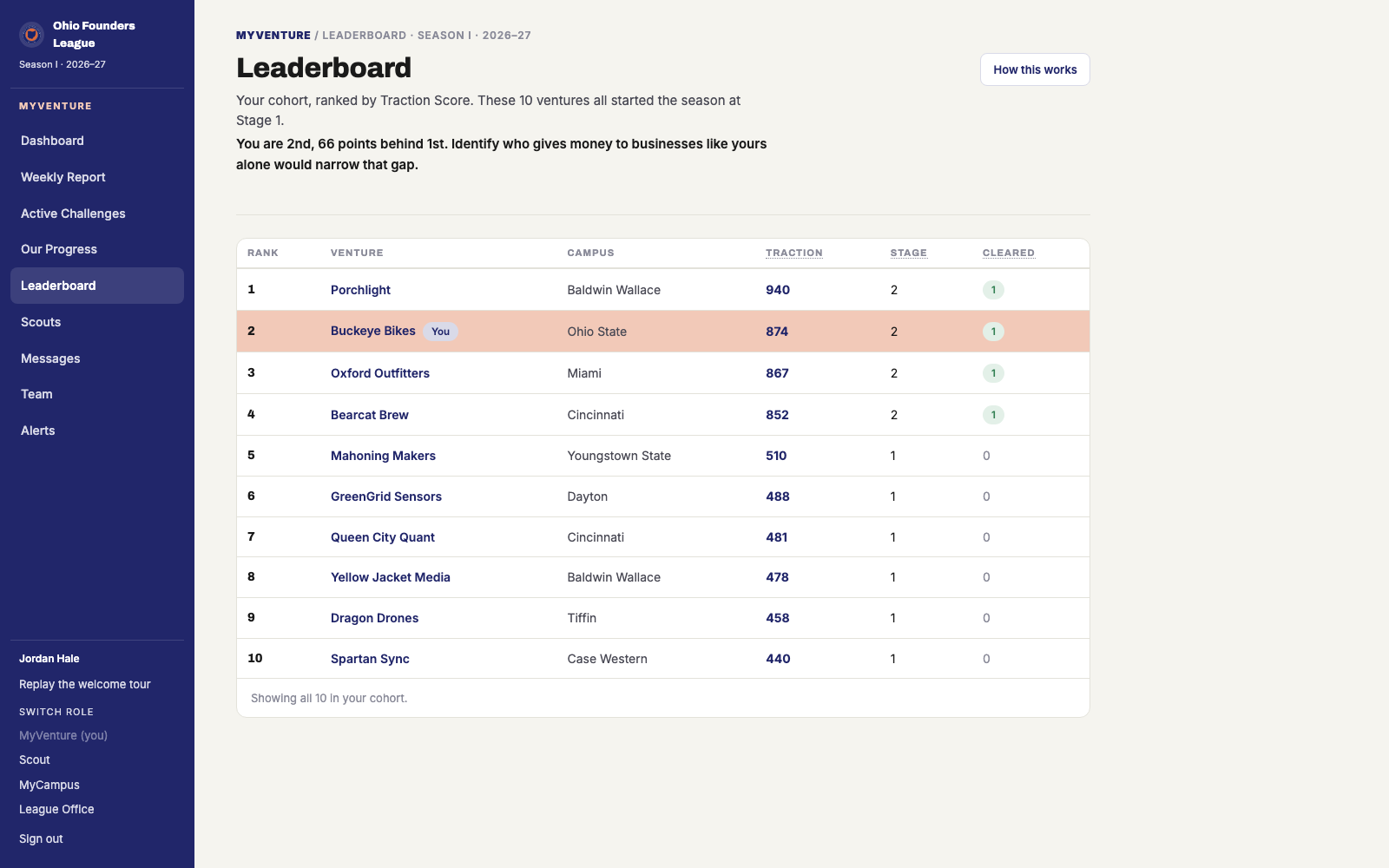
You are ranked against ventures that started where you did. Scouts put you in their portfolio. Judges decide the rest.
Cohorts exist because a fair race needs a fair starting line. Your cohort is every venture that started at your stage, and every comparison the League makes, from the dashboard to the Playoff, is within it.
Scouts exist because a venture with people behind it is a stronger venture. Students, faculty, staff, and alumni get a portfolio with 5 slots and pick the ventures they believe in. No money is involved at any point. A Scout's points are the Traction Score points their ventures earn after the pick, and a Scout can name one captain that counts 2x, so the only way their pick pays is if you build. They are told every time you earn points and every time an audit takes points away. The number of portfolios you are in is your Scout share of League Scoring. Recruit them.
Scouts are also people who can help. Every Scout can publish a profile: who they are, what they know, and how they want to help, from feedback to customer introductions to mentoring. The Scouts page in MyVenture searches those profiles. Ask for an intro, and if the Scout accepts you can message each other on the platform. Scouts can also leave comments on your venture page and introduce themselves to you from the Market.
League Scoring decides the Regional Championships and the State Championship: Judges 60, Traction 30, Scouts 10. Five judges score six criteria from 1 to 5, and the composite normalizes to 60. Traction is your cohort rank on cumulative VAA. The split is deliberate: judges project what you could become, traction proves what you did, Scouts show who believes it.
- 1Check your cohort rank every week on the dashboard and the Leaderboard.
- 2Open Scouts in MyVenture. Each card shows who the Scout is, how they help, what they know, and how to reach them. Filter by the help you need, by expertise, or by campus. Scouts who already back you are marked.
- 3Request an intro with a short note. When it is accepted, Messages opens between you and you both see each other's email.
- 4Reply to comments on your dashboard. A Scout who asks a question is a Scout deciding whether to pick you.
- 5Build your pitch to the six criteria below. You get the rubric in advance. There are no prescribed slides.
| CRITERION | 1 | 3 | 5 |
|---|---|---|---|
| Problem & Market Opportunity | Assumed, not validated. Market undefined. | Validated by real customers. Market meaningful. Entry point defined. | Undeniable problem, extensive validation. Massive, well-timed market. |
| Solution & Differentiation | Vague, no differentiation. | Clearly solves the problem with identifiable differentiation. | Defensible moat. Demonstrated product-market pull. |
| Team & Execution Capability | Lacks critical skills. No execution evidence. | Core skills present. Consistent execution. Learns from mistakes. | Exceptional expertise. Coachable, resilient, hungry. |
| Business Model & Economics | No clear revenue model. | Defined and partially tested. Path to revenue articulated. | Proven model with strong economics. |
| Growth Potential & Scalability | Limited, lifestyle scale. | Credible ambition. Can articulate the 10× version. | Sees what most don't. Plan to reshape the market. |
| Momentum | Stagnant. No forward motion. | Steady progress. Positive trend. | Clear inflection point. Accelerating across dimensions. |
Score Sandbox
This runs the League's real scoring engine. Pick a stage and see its starting credit, type one week of numbers against the stage's action budget, tick the challenges you would have done, add revenue, then verify the Final Challenge and watch the stage get credited in full. Switch stages to see how the rates shift toward the work that matters next.
Stage 0 starts at zero. Every stage you clear is credited in full. Stage 0 is worth 250: 5 × 10 challenges, a 100-point action budget, and the 100 bonus.
Customer conversations 1 per conversation (10+ min) | × 5 = 25 | |
Outreach sent 1 per 10 messages | × 3 = 6 | |
Content published 1 per piece | × 3 = 3 | |
Events attended / pitched 1 per event | × 2 = 0 | |
Contracts / proposals sent 1 per document | × 1 = 0 | |
Deals closed 1 per signed deal | × 2 = 0 | |
New customers acquired 1 per customer | × 2 = 0 | |
Product updates shipped 1 per meaningful release | × 2 = 0 | |
Mentor meetings completed 1 per meeting (30+ min) | × 2 = 2 |