Scout Guide
This guide explains the Scout game the way the League designed it: how you pick, how points work, why there is no money, and how founders can find and reach you. Read it once before your first pick.
Watch it first. Four minutes, narrated, on the real screens.
What a Scout is, and why there is no money
You back student ventures you believe in. You get five slots. When a venture you picked earns Traction Score points, you earn the same points.
The League needs a way for a whole campus to stand behind its founders that cannot be bought and cannot be gamed. Money would do both. So the Scout game runs on attention instead: you read the ventures, you pick the ones you believe in, and your score is exactly the progress they make after you picked them. Nothing is deposited, nothing is paid out, and nothing you do moves a venture's score. Only the founder does that, by building.
Five slots is enough to spread conviction and few enough that every pick costs you something. A Scout with fifty picks is not scouting. A Scout with five has to choose, and the choosing is the point.
Scouts win recognition. The Scout leaderboard ranks every Scout in Ohio by points, and the ventures you back get ten percent of their League Scoring from how many portfolios they are in. Your picks help them onto the stage.
- 1Register with your name, email, university, and a display name. That is the whole sign-up.
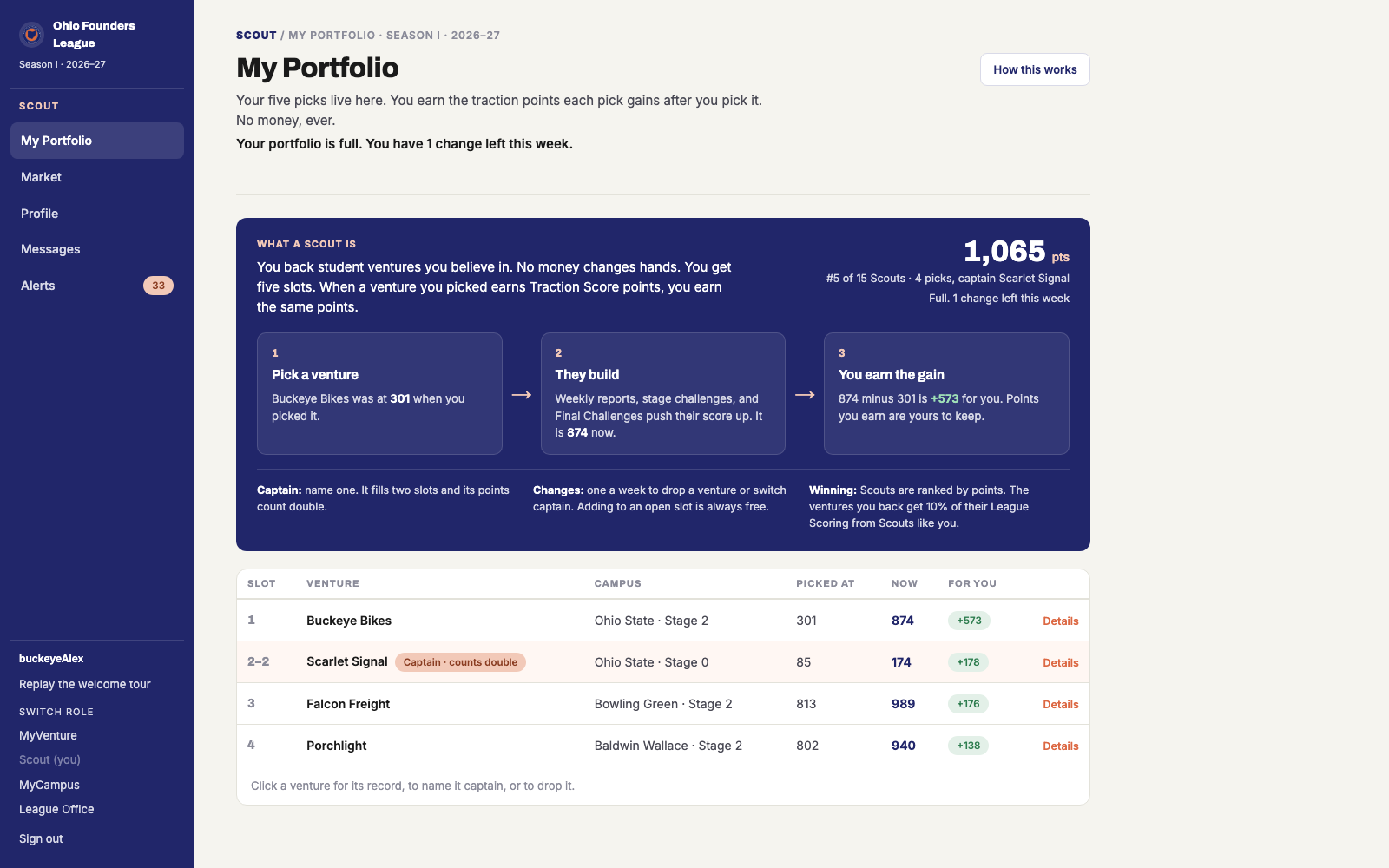
- 2Open My Portfolio. The panel at the top explains the game with your own numbers once you have picks.
- 3Fill your five slots from the Market. Adding to an open slot is always free.
How points work, and why timing matters
Your points are the Traction Score a venture gains after you pick it. Pick at 40, they reach 90, that is 50 points for you.
Scoring the gain after the pick, not the score itself, is what makes early conviction worth something. A venture at 900 is a safe pick that earns you almost nothing. A venture at 40 that reports every week and clears its Final Challenge can earn you hundreds. The Market shows each venture's score and its gain this week for exactly this reason: momentum is what pays.
The biggest single gain a pick can give you is a cleared stage. Every stage is worth a fixed amount, from 250 at Stage 0 to 830 at Stage 4, and when an official verifies a venture's Final Challenge the whole stage is credited at once, with the bonus multiplied by 1.5 if they cleared it within 4 weeks. So a venture with its challenges nearly done and its action budget nearly full is about to jump. The Market shows how many stages each venture has cleared this season; read it as a speed gauge.
The captain is your one high-conviction call. Name a captain and it fills two of your five slots, and every point it earns counts 2 times. It costs you a slot, so it only makes sense for a venture you expect to keep climbing.
Points you have earned are yours. If you drop a venture, the points it earned you stay on your total. If a venture is audited and loses points, you lose the same points from that pick. That is the only way your total goes down, and it is the same rule founders live by.
- 1Watch the This week column in the Market. A low score climbing fast is worth more than a high score standing still.
- 2Watch the Cleared column too. Stages cleared this season is the clearest sign of a rocketship, and the next clear is a jump you want to hold through.
- 3Name a captain from a pick's panel. Naming your first captain is free.
- 4Check your points, rank, and slots at the top of My Portfolio. The Leaderboard page ranks every Scout in Ohio, and shows the ventures, cohorts, and universities beside them.
| RULE | DETAIL |
|---|---|
| Slots | 5. A captain fills two. |
| Your points | Traction Score gained by each pick since you picked it, captain counted double. |
| Adding | Always free while a slot is open. |
| Changes | One a week: drop a venture or change your captain. Resets Monday. |
| Dropping | Points already earned stay with you. |
| Audits | If an official strikes points from a venture, your pick loses the same points. |
The Market, and how to read a venture
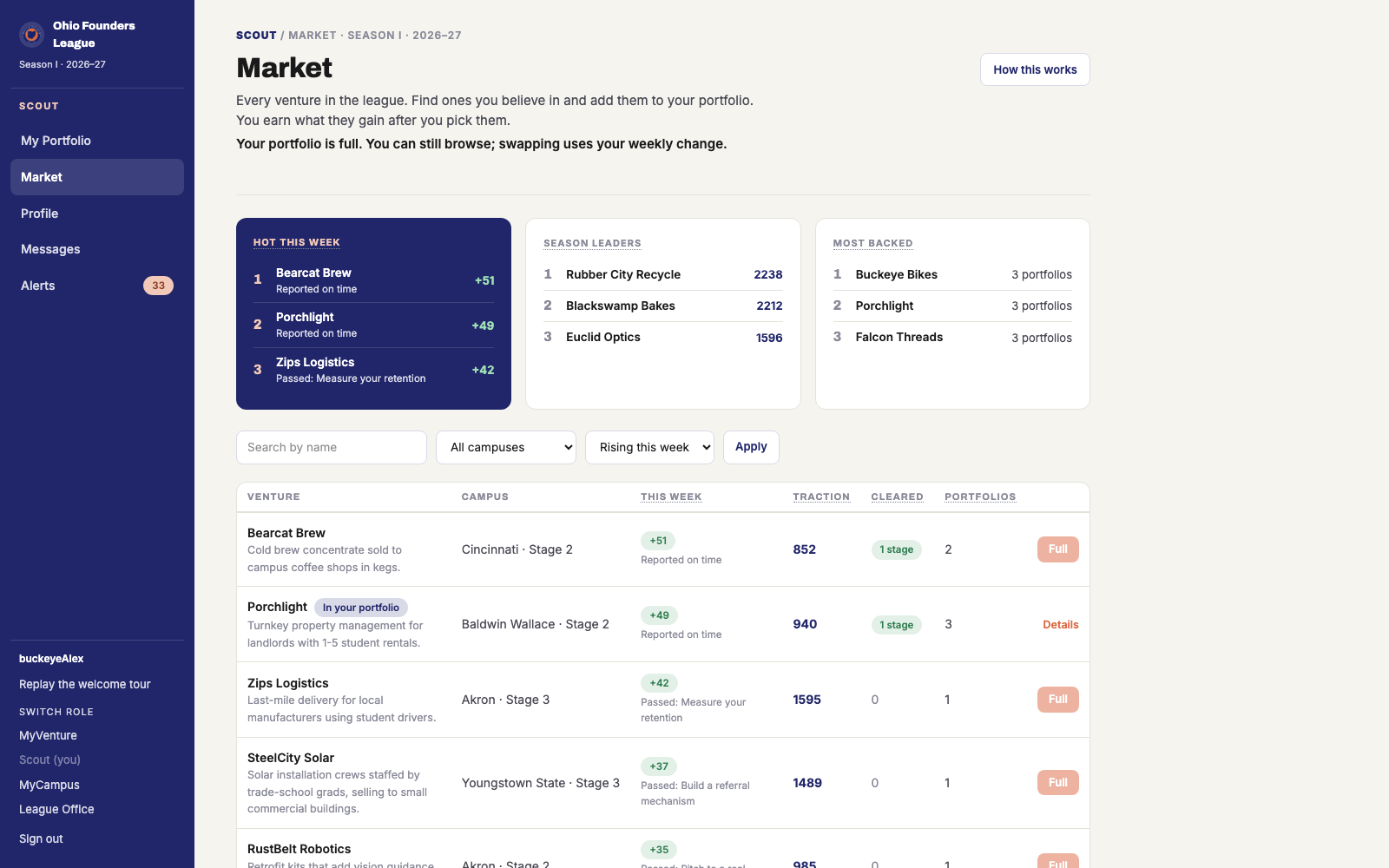
Every listed venture in the league, with its Traction Score, its gain this week and why, and how many portfolios it is in.
Everything a Scout needs to decide is on one page because the decision should be about the venture, not about hunting for information. Hot this week shows momentum. Season leaders shows who is ahead. Most backed shows where other Scouts' conviction is pooling, which tells you something even though popularity never changes your points.
Click a venture and its panel slides in: the story, the score, this week's gain and the reason for it, the recent record of reports and challenges, and the comments other Scouts have left. Read the record before you pick. A venture that reports every week is telling you who it is.
- 1Sort by Rising this week, Highest traction, or Most backed. Filter by campus. Search by name.
- 2Click a row for the panel. Add to My Portfolio from the panel or straight from the row.
- 3Leave a comment or a question on any venture. The founder is told, and other Scouts can see it.
One change a week, and why
Drop a venture or change your captain once a week. Adding to an open slot never counts.
Without a limit the game becomes churn: swap into whatever gained points yesterday, swap out when it stalls. One change a week means a pick is a commitment. You have to read the record, form a view, and live with it for at least a week. That is what scouting means.
Adding is free because an empty slot earns nothing and the League wants every Scout fully in the game. The limit is only on undoing a choice.
- 1Open a pick's panel from My Portfolio to drop it or to name it captain.
- 2Your changes left this week show at the top of My Portfolio and in every venture panel.
- 3The count resets on Monday.
Your profile, and why founders search it
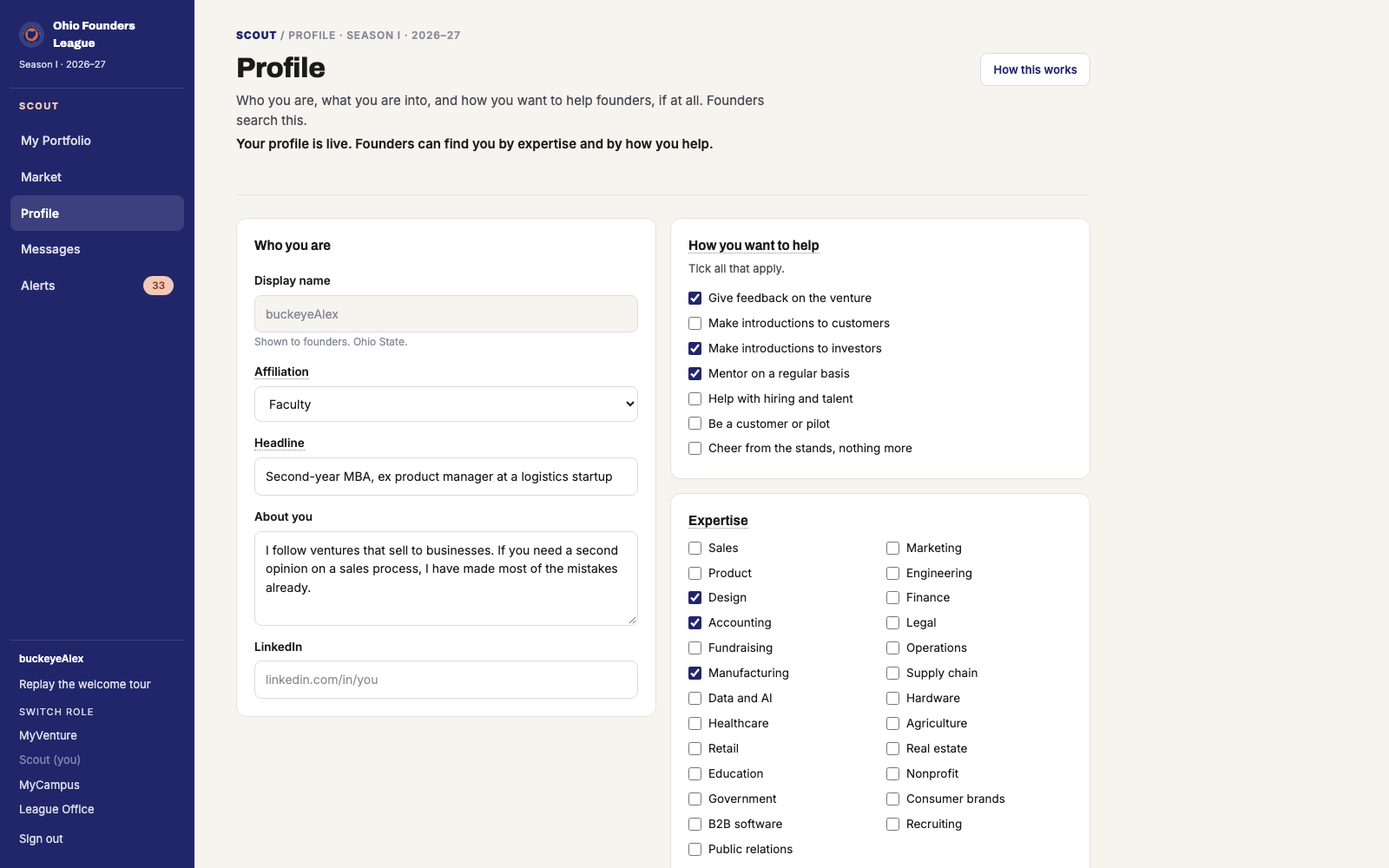
Who you are, what you know, and how you want to help, if at all. Founders search this to find Scouts who can help them.
A Scout who knows medical device sales, or has run a restaurant, or writes small angel checks, is worth more to a founder than any number of points. The profile is how that value gets found. Founders search by expertise, by the kind of help offered, and by campus, and Scouts who already back a venture are shown first.
How you want to help is a checklist because saying no is a fine answer. Feedback, customer introductions, investor introductions, mentoring, hiring help, being a customer, or just cheering. Tick cheering only and founders will not ask you for more.
Availability is a checklist too: times of day and how to reach you, email, text, or messages on the platform. Your email and phone are never shown until you accept an intro from a founder. Platform messages need nothing shared at all.
- 1Open Profile. Fill in the headline, a few lines about you, and the tags.
- 2Tick how you want to help and when you are reachable.
- 3Leave the profile visible so founders can find you, or hide it and keep playing.
Intros, messages, and comments
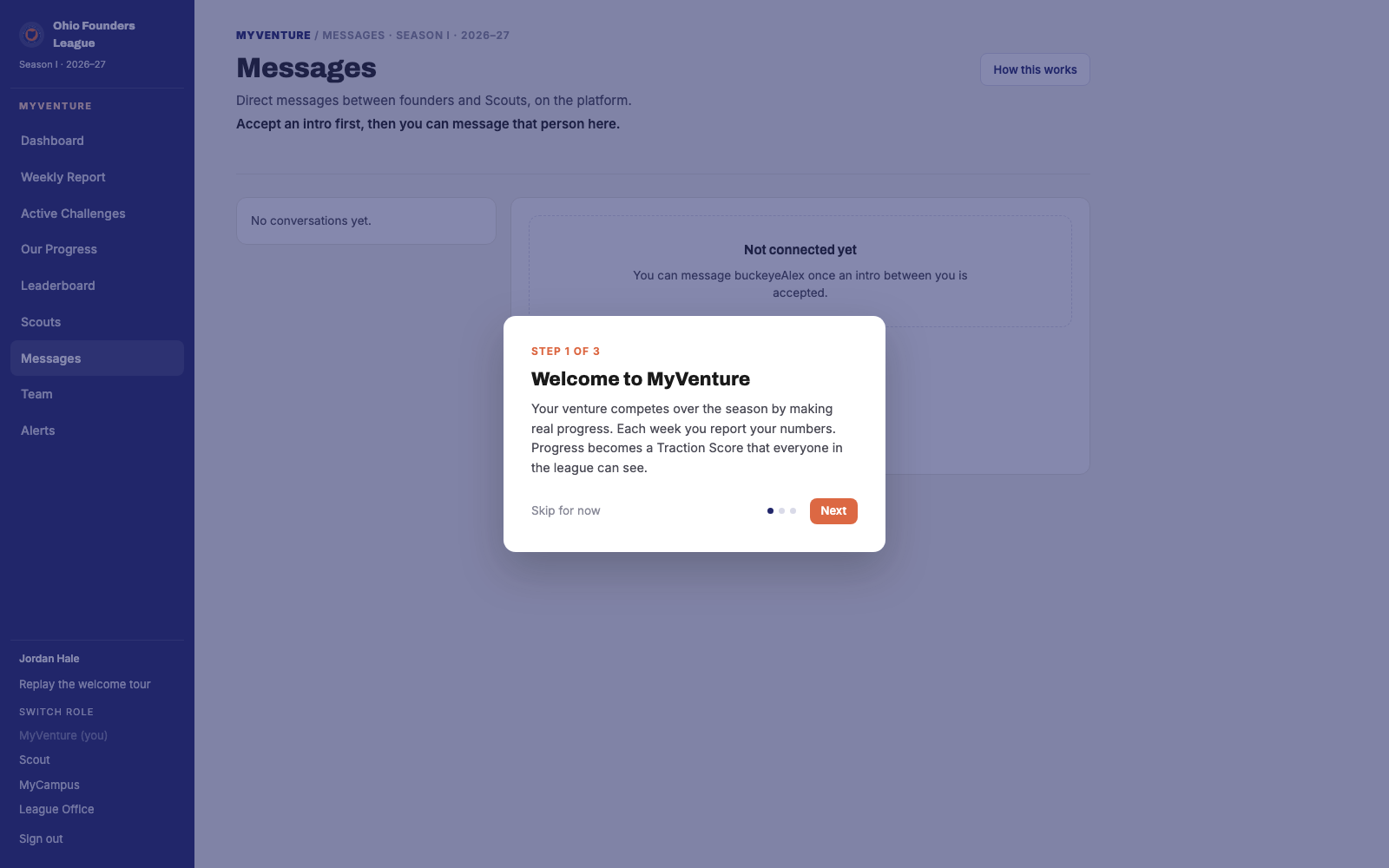
Founders can ask you for an intro. You can introduce yourself from any venture. Accepting opens messages on the platform and shares email both ways.
Every connection is wanted on both sides because either side can start it and the other has to accept. A founder reads your profile and sends a short note. Or you read a venture and introduce yourself from its panel. Nothing is shared until the other person says yes, and declining is quiet.
Once connected, Messages keeps the conversation on the platform, with an alert when something new arrives. If you offered email or text, the founder sees those too. Comments are the public layer: a question or a note on a venture's page that the founder and every other Scout can see.
- 1Introduce yourself from the Meet the founder section of any venture panel.
- 2Reply to founders' intro requests from your Profile page. Accept or decline.
- 3Open Messages to talk with anyone you are connected to. The count in the sidebar shows unread messages.